Brief to Concept
Food Manufacturing · Concept & Storyboard Development
Client:
Confidential (UK Food Manufacturer).
My Role:
Creative Direction, concept development, visual style, storyboard.
Timeline:
3 days from brief to storyboard. Planned 5 days for animation.
Outcome:
Project cancelled at pre-production stage. Storyboard completed and delivered.
The Brief:
A major UK food manufacturer needed a 4K CGI animation, approximately three minutes long, demonstrating their full cottage pie production process from raw ingredient intake through to dispatch. The film needed to follow the journey of the product as it moved through the facility, pausing at key process stages and using on-screen annotation to identify each step. The end goal was a retailer pitch presentation, with a hard deadline driving the timeline.
The brief arrived as a combination of a dense multi-stream process flow document, a CAD facility layout and a short email outlining deliverables. There was no creative direction, no visual reference and no precedent from the client. The creative approach was entirely mine to define.
The Challenge:
The facility itself was the complexity. The production process runs across two parallel streams - potato preparation and meat and vegetable filling — which converge at the assembly and packaging stage before passing through a large automated storage matrix and on to dispatch. Understanding how those streams related spatially and sequentially, well enough to build a coherent camera narrative around them, required genuine immersion in the brief documents and independent research into the specific machinery involved.
The other challenge was time. Three days to storyboard a three-minute 4K CGI animation meant the visual approach had to be both creatively considered and practically achievable within a compressed production window.
My Approach:
I spent the first part of the project decoding the process flow and CAD layout, researching the individual machines by name, studying existing food manufacturing reference films and using AI tools to help interpret the more technical aspects of the documentation. The goal was to understand the factory well enough to direct a camera through it believably.
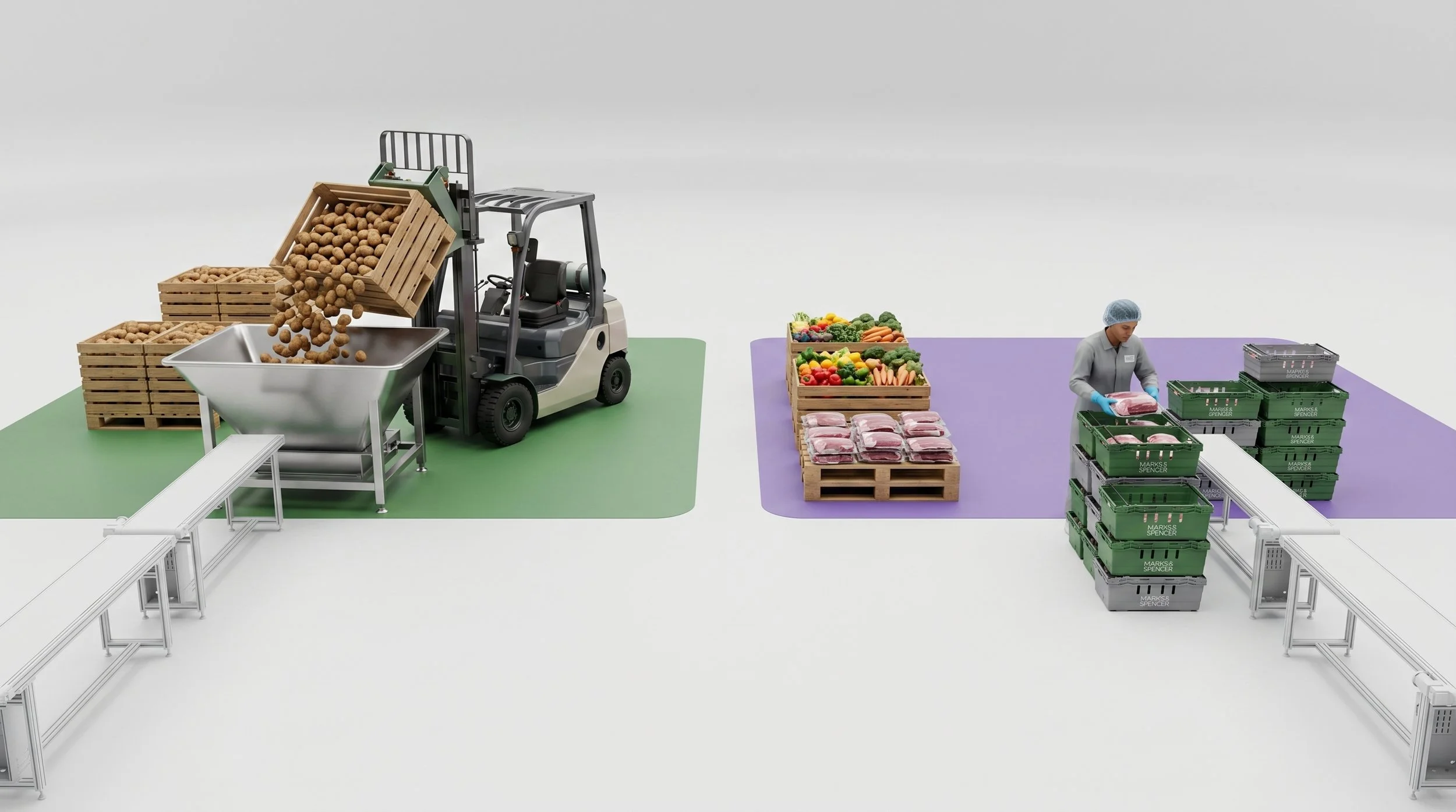
Once I had a clear picture of the process, I developed a visual style built around simplicity and clarity. Rather than attempting a photorealistic factory environment, I chose a clean, graphic 3D aesthetic using distinctive colours as a way to distinguish different production zones and make a genuinely complex facility legible at a glance. This approach also had a practical dimension — a cleaner render style was faster to produce, which mattered given the timeline.
The storyboard was built across 13 frames, structured as a continuous camera journey through the facility from intake to dispatch, with each frame corresponding to a key process stage.
Storyboard:
View the storyboard and scene by scene details I created in Figma.